
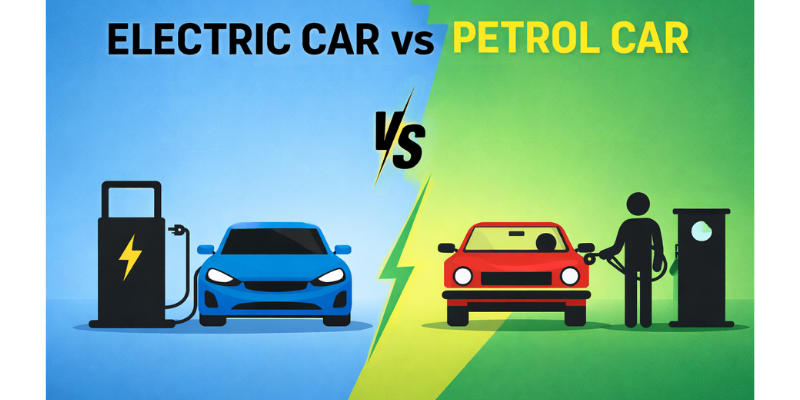
Choosing between a petrol car and an electric vehicle (EV) is one of the most common questions for today’s car buyers. With rising fuel prices, evolving government policies, and rapid advancements in electric mobility, making the right choice depends on your driving habits, budget, and long-term plans.
This guide explains the real differences between petrol cars and EVs to help you make an informed decision.
Understanding Petrol Cars
Petrol cars have been the traditional choice for decades and continue to be popular due to their familiarity and wide fuel availability.
Advantages of Petrol Cars
- Fuel stations are easily available
- Lower upfront purchase cost
- Familiar driving and maintenance experience
- Suitable for very low or occasional usage
Limitations of Petrol Cars
- Petrol prices increase almost every year
- Higher running and maintenance costs
- Produces pollution and harmful emissions
- May face stricter regulations in the future
Understanding Electric Vehicles (EVs)
Electric vehicles are transforming the automobile industry by offering cleaner, smarter, and more cost-effective mobility solutions.
Advantages of EV Cars
- Very low running cost compared to petrol
- Zero tailpipe emissions (environment-friendly)
- Smooth, quiet, and comfortable driving experience
- Lower maintenance due to fewer moving parts
- Government incentives and tax benefits
- Ideal for city driving and daily commuting
Common EV Myths (Explained)
Charging takes too long
Most EV owners charge at home overnight. For daily city use, overnight charging is more than sufficient.
Battery replacement is very expensive
Modern EV batteries are designed to last many years and come with long warranties.
EVs are not suitable for Indian roads
New-generation EVs are built for Indian road conditions, traffic, and climate, offering strong
Petrol vs EV Car: Quick Comparison
Feature | Petrol Car | Electric Vehicle |
Fuel Cost | High | Very Low |
Maintenance | High | Low |
Environmental Impact | Polluting | Eco-Friendly |
Driving Experience | Noisy | Smooth & Silent |
Future Readiness | Limited | High |
Which One Should You Choose?
Choose a Petrol Car If:
- You drive occasionally
- You live in an area without charging access
- You plan to use the car for a short duration
Choose an EV If:
- You drive daily within the city
- You want lower running and maintenance costs
- You care about sustainability and future mobility
You want advanced technology and premium comfort
Why Electric Vehicles Are the Future of Mobility
India is moving steadily toward electric mobility with better charging infrastructure, supportive government policies, and increased awareness about sustainability. EVs are no longer a trend—they are becoming the future of personal transportation.
Modern electric cars now offer:
- Premium design
- Advanced safety features
- Strong performance
- Long-term cost savings
Looking to Explore Electric Vehicles?
If you’re considering switching to an electric car and want expert guidance, YouWe VinFast is an official partner offering the latest VinFast electric SUVs with transparent pricing and complete customer support.
What YouWe VinFast Offers:
- VinFast VF 6 & VF 7 electric SUVs
- Test drive assistance
- Easy booking and finance options
- Reliable after-sales support
- Showrooms in Okhla, Bhikaji Cama Place & Faridabad
Frequently Asked Questions
What is the main difference between a petrol car and an electric car?
The main difference is the power source. Petrol cars run on internal combustion engines using fuel, while electric cars run on batteries powered by electricity. EVs produce no tailpipe emissions and generally cost less to run.
Which car type has lower running costs?
Electric vehicles have much lower running costs than petrol cars. Electricity is cheaper than petrol, and EVs require less maintenance because they have fewer mechanical parts.
How often does an electric car need maintenance?
Electric cars require less frequent maintenance compared to petrol cars. They do not need oil changes, and components like the engine and gearbox are simpler, reducing servicing needs.
How long does it take to charge an electric car?
Charging time depends on the charger type. Home charging usually takes several hours and is commonly done overnight. Fast chargers can charge an EV much quicker for short trips or emergencies.
Book a Test Drive Today
Still unsure whether to choose a petrol car or an EV? The best way to decide is to experience it yourself.
 Call us today or :+91-8586017000
 Book a test drive online at youwevinfast.com
Make a smarter, cleaner, and future-ready choice with electric mobility.